Showing posts with label Writing. Show all posts

Saturday, April 16, 2022

What Ray Bradbury Didn’t Teach You About Short Stories (and Why)


(I wrote this piece for the Ray Bradbury course thrown to me mid-semester by circumstances outside my control. They seem to be an excellent bunch of students but have some trouble in discussing the short stories on the reading list – and in writing first drafts of stories allegedly “inspired” by Bradbury’s works. It occurred to me that most of the students hadn’t a clue to what short stories are, and maybe someone had better tell them before they get any further in this life. Besides, this isn’t a lit class but a “Craft and Process Seminar,” whatever that is. What’s more “Craft and Process” than learning what a short story is? Therefore… )


“The purpose of trial and error, imitations and experiments, constant slaving through uncertainty and despair is twofold: to acquire merciless self-discipline; to acquire conscious story patterns and reduce them to unconscious practice. I’ve often said that you become a writer when you think story, not about a story.”

– Alfred Bester, introduction to “Time is the Traitor” in Starlight: The Great Short Fiction of Alfred Bester (1976)


Even in his book about writing, Zen in the Art of Writing, Ray Bradbury never answered a certain simple, basic question that may have been asked of him a million times: What is a story?

If anyone knew the answer, it was Bradbury. Novels, poems, plays, screenplays, essays notwithstanding, Bradbury is best known as an author of short stories.

I don’t think it was a deliberate dodge. Bradbury knew so well what stories were, he may have taken for granted that everyone else knows what a story is. 

And the reason for that, I suspect, is this: Bradbury read so many stories, and read so extensively, that he thought in stories, i.e. his thoughts naturally took story-shaped ideas. It wasn’t necessarily some sort of gift or talent. You have to work at it.

Many people starting out as writers are not as familiar with short stories. They may have read a few in school, but much of what takes up their self-motivated reading are novels. Novels, of course, are stories too, but they can take a number of twists and turns and explore sidelines; or they can be stacks of stories, one atop the other; or interwoven stories of many characters in many places at many times.

I’ve spent a good part of my life teaching folks about short stories. I’ve written a lot about it, too. And I’ve directed aspiring writers to a lot of what has been written about short stories by others. It’s what I do.

There’s no need to bore you with a lot of that at this time, or maybe at any time, granted you have an intrinsic sense of what makes one batch of pages a story and another batch of X-number of pages of prose fiction – a fragment, a scene, a chapter, but not a story.

Within the traditions of storytelling, it’s simple enough to distinguish five basics elements (I don't call them parts, though many others do) you will find in every story. Or, if you don’t find them in a story, it’s because the author has made their presence felt by their absence, or through some other clever redistribution of their weight upon the story as a whole. You’ve got to have these elements or you don’t have a story. And it doesn't matter how these elements appear, in what structure they may be used. Some teachers talk about “three-act structure,” but you don’t need three acts to tell a story, as long as the story has all the elements. The story doesn’t even have to look like a story: it can disguise itself in an imitation of another form, like a text message, or a journal entry, or a piece of journalism. It can look like a postcard, but if it has all the elements, it’s a story.

What are those elements? The answers will seem obvious, but think about them for a moment. Very often, beginning writers mistake elements or discard them, or consider one or the other of them unnecessary, or covered elsewhere.

First, one needs a character/protagonist. The person (even if the person is an object, or sometimes a collective) is who the story is about. The focus upon this character helps shape what the story is about.

Second, the character has to have a sort of defining motivation. Characters can have all sorts of motivations about many things, but there's usually one interest, one desire, one need, that defines the character most specifically, at least for the purposes of this story.

Third, the story has to happen somewhere. The “somewhere” can be described in great detail or it can be sketched out with a minimum of particulars. But even when sketched out, it has to have the feel of a real place, even when the place is completely unreal (Oz, Narnia, Pluto, Hyperborea).

Fourth, the character has to be confronted with . . . stuff!

An opposing force. A nemesis. Something that prevents or obstructs the character’s defining motivation. This can come from outside the character, or from within the character. Ideally, the external force working against the character is a reflection of an inner force that prevents the character from doing what needs to get done.

Fifth, the collision between the character’s defining motivations and the stuff – the forces opposing them – must result in a significant outcome. It can and is often called the resolution. It can be a victory or a defeat. It can be a standoff. It can be subtle or it can come in accompanied by a brass band and twelve sticks of dynamite. No matter how the outcome is reached, it needs to result in a change. The change may be in the character’s self, or it may be in our perception of the character. If we can’t answer the question “What changes?” by the end of the story, either something’s missing in the story or in our reading of the story.

That’s pretty much it. Sounds easy, but often the most difficult things to do are also the simplest.

And it works. Try it. Think over any of the Bradbury stories you’ve read so far in this class. You'll find all these elements there. Try it with the stories we’ll be reading next. After you’ve read the story, ask yourself: “Who’s story is this?” “What do they want?” “Where is this happening?” “What gets in the way?” “How does it all work out?”

I trust you’ll find the answers in any story (even in bad stories sometimes), by Bradbury or by any other author you choose to read. And you’ll also discover that the elements are most interesting when they also are most cleverly hidden and difficult to discern.

And once you have seen how these elements work in the stories you read, it’s possible that you can more readily apply them to the stories you write as well.


Tuesday, January 4, 2022

Two-way Street


The other night I awoke from a dream and found myself compelled to write down some thoughts that floated in my head as sort of the after-burn of dreaming. And that was about what “fantasy” – of the literary type – teaches us. 

Last night, the thoughts preceded the dream, and had to do with science fiction. 

I was reading a manuscript a former student asked me to read for her and comment on. I was no more than a few pages into it when I found myself stymied. It was written about a future world someone might have written about in the 1940s, where, along with humans, there were two kinds of humanoid robots. And it seemed so “retro” that I had to write to the author before I could go any further. I wanted to explain that the conversation about artificial intelligence had progressed a great deal in the seventy-plus years since Isaac Asimov started kicking around ideas about robots.  

There were many presumptions made about “intelligence” and “human behavior” and “self-awareness” and “autonomy” in those days. In a way, we know a lot more about such things, but in another way, we know much less – and in this I’m using the word “know” in a somewhat sloppy way. It’s not so much what we know as what we presume to know.  

In other words, perhaps, we define the problem in such a way as to arrive at a simple solution. It’s not about the “solution,” so to speak, but the definition. If the definition is off, the solution doesn’t really “solve” anything. 

It brought me back to my reading of Louis H. Sullivan’s The Autobiography of an Idea, published the year of his death in 1924. 


He [Sullivan himself, writing about himself in the third person a la Henry Adams] had worked out a theory that every problem contains and suggests its own solution. That a postulate which does not contain and suggest its own solution is not in any sense a problem, but a misstatement of fact or an incomplete one. He had reached a conviction that this formula is universal in its nature and in application. ... if one wished to solve the problem of man's nature, he must seek the solution within man himself. ... 


When the notion of humanity sitting at the top of the Great Chain of Being was considered indisputable, it was easier for our ancestors to figure out their priorities. Today, we’re not only uncertain of our position on the chain, but whether or not the chain exists at all. 

The more we know, the more we sense how much more there is to know. The more knowledge we gain, the more we understand how much of our universe is perhaps unknowable – at least in the immediate future. 

And I found myself thinking: the important thing in science fiction is not what we know, but what we don’t know. That’s what makes it fun and thrilling and fascinating – discovering the limits of what we know and speculating upon all that we don’t. 

And then I went to sleep. 

And then I dreamed about the house where I grew up. 

Except that it wasn’t the house where I grew up, not physically. It looked older, bigger. But it did have one thing my real house had: a crawlspace. 

And in the crawlspace I discovered that about a dozen college students had snuck in and were living there. They had fashioned their own little cubicles, and their own cubby spaces where they stored their books and laptops and clothing. They had their own sleeping bags and lights. It was all a very neat arrangement. But once I discovered it I had to figure out if I should allow them to live there or throw them out. After all, they were living there without permission of anyone. 

But they were living there because, of course, they had no money. And I could understand that. So I decided that I would let them live there and, if they ever found themselves with a little money to spare, to make a “donation.” 

Unfortunately, the house wasn’t mine. And eventually my brother arrived. And it was understood that he had power of attorney over the “estate,” such as it was, and would throw the students out or call the police on them.  

I awoke before any such eviction occurred. I felt bad about the students and what might happen to them. I hoped they would find another crawlspace somewhere.  

But I felt good about my decision not to evict them. Were it my decision to make, they could have stayed as long as they wanted. 

There was all sorts of other stuff happening in the dream. My parents were there, though dead – their presence was in every room. Pam ordered groceries, and two African immigrants who delivered them were waiting for Pam to fold up the boxes so they could be used for the next delivery. And I had an amusing exchange with a gentleman from Goodwill when I discovered that the uniform shirt he was wearing was exactly the same make as the one I was wearing. I have no idea how this all may have fit with the alleged “big thought” I went to sleep with: Science Fiction is not about what we know, but what we don’t know. 

Maybe there isn’t a connection, but I suspect there is. 

Suspect, but don’t know. 

And somehow, for some reason, I’m perfectly okay with that.


Tuesday, April 30, 2019

Style Isn’t Story

Sometimes, not too often, but still often enough, I get a student who believes that what you say in a work is less important than the way you say it.
“It’s all style, man! Who cares what it’s about?”
Yes, dear friends. These poor unfortunates are still with us.
Stories, if they’re to be considered at all, are just excuses to exercise one’s style – or should I put quotes around that word? Because what “style,” as these students practice it, consists of, for the most part, are certain distinctive traits of other authors placed in other contexts by the students emulating them. They insist they’re being “themselves,” but they’re really trying on stuff, experimenting, exercising – trying to figure out not who they are, but who they want to be – which is perfectly okay. That’s how you do it. That’s how you find out who you are: as a person, as a writer – as a person who is a writer. They don’t know it yet, but they will eventually.
How do I know?
I used to be one of them.
Back in the 1970s, when there were so many styles to choose from, like so many different hats to try on. And the “literary” side of the street had grown bored with telling stories. More so: they believed it was all in the technique, that the pyrotechnics was the show, and to settle on telling a compelling story to an audience was to lower yourself as an artist. It was like designing a chair that someone might actually enjoy sitting in. How dull! How utilitarian!
The artists above, the rabble below.
Usually, I shrink back from using terms like “elitist,” because they’re usually engaged in political forums and take on political taints that can’t be rinsed off. But one cannot view aesthetics that distinguish “highbrow” from middlebrow, to lowbrow, to no-brow, without feeling a sort of tyranny of exclusivity. “Don’t try this at home, kids. This is high art we’re talking here. Go back to your comic books.”
Well, move over, literati! I was going to show them what real art was all about.
Yeah, right.
Let’s put it this way: I didn’t have a mind that was particularly attuned to nuance. It wouldn’t surprise me if I wasn’t alone in that, back then, for kids my age, with overactive imaginations and a great yearning to be nearly anywhere except where they were. I wanted spectacle and pyrotechnics and just about anything that blew a hole through the status quo.
I liked the nouvelle vague movies and experimental films that were all quick cutting and filters and effects and jumping around in the narrative, and interminglings of fantasy and brutal realism. I liked the dynamic perspectives of Jim Steranko comics and the surrealism of Steve Ditko (I was more in love with his work on Dr. Strange than anything he did with Spiderman). When I discovered New Wave science fiction, I was all for it. The less I understood of what I read, the better I thought it must have been.
“Wow! This is totally incomprehensible! It must be a work of genius!”
I wanted literature to be a huge ladle dipped into the unbridled unconscious, spread out on the page without benefit of organization or interpretation. The stranger the better. In music, I was thrilled by Captain Beefheart, Sun Ra, The Stooges. I was looking for new languages and new grammar in visual expression, in sounds, in written works. No boundaries. No horizons. No walls. No “end” title.
Problem was, I didn’t know what I was rejecting, or if I was rejecting anything by embracing all these apparent manifestations of “the new” (And some of it, in spite of my generalizations, really were brilliant and wonderful; on an instinctual level, I was pretty good; on an intellectual or aesthetic level, I was a complete idiot).
I learned the history of literature backwards – of culture in general. I started with experimental writers and worked my way, years later, back to Chaucer and Beowulf.
Problem was, I didn’t know shit. I didn’t care, either.
But the further my interests went, the further I wanted – needed – to know more of that history.
One of the insights I picked up, as I increased my knowledge and experience, was that much of what I thought of as innovative had roots that went back to the very origins (or as far back as we could find) of the forms that interested me. For example, no postmodernist impressed me more than Sterne, Fielding and Cervantes.
Every age is an age of innovation and discovery. Some of these eras get more attention than others, and the attention varies from subsequent era to era. One period of the past speaks, or reflects, or echoes, a later age more directly than others. That’s when an author, or a whole era of literature is “rediscovered.”
Eventually, it became clear to me what had probably been clear to most of my contemporaries all along: innovations and experimentations in art forms are a means and not an end. The most successful explorations of “style” are the product of necessities driven by other needs. Something we want to say or tell can’t be told any other way.
We do what we have to do to make the work of art we want to make. While we’re doing it, we call it, “getting the job done.” Afterward, we may call it “style,” but rarely before. Style is something someone else calls your writing. You just call it “work.”
Simple enough, but it took me about thirty-one years to get there.
Now, it becomes my job to guide students away from the excesses in which I indulged, and produced reams and reams of unreadable drivel.
Can I do it? Maybe with some students. With others, no.
This is both good and bad. Good because the itinerant student in question has the intrinsic stubbornness that makes for a good writer. But that only works when the writer is, well, right. If not, the writer will spend a long, long time (like me) finding out that the hill chosen to die upon is actually two hills over.
We all live and learn. Some faster than others, but we learn. If you ever stop, it’s almost as if you’ve stopped being a writer. You’re just going through the motions.
Never sacrifice clarity to style. Style should enhance clarity, otherwise it’s holding you back.
Never sacrifice story to style, otherwise you’re just putting fancy wrapping paper around an empty package.
So I think: what the hell do I know? I’m just a guy who stumbled into a teaching job, and what I know about writing should be considered suspect at best. What does someone who really knows about writing have to say?
The nearest book on writing at hand is Worlds of Wonder by David Gerrold. I open it up at random and the gods of serendipity smile upon me.
Page 234:

You have to know what you want to say.
If you have no clear goal, then you’re just fumbling around, smearing paint on canvas, pounding randomly on the piano keys, and throwing yourself about on the stage in semblance of a performance. If you don’t really know what you’re evoking, then all the exercises of style and form and tense and person will not disguise it.

On the previous page (233), in describing the New Wave sf writers:

In the breakaway from traditional form, what had also occurred was a disinheritance of the storytelling structure. Much of this experimentation was necessary, creating an important expansion of the range of ideas and treatments available to authors, yet it also gave comfort to the idea that traditional forms were worthless and should be discarded. The result, for a while, was a nihilistic abandonment of story.
Fortunately, this trend didn’t last long –

That’s the word from David Gerrold, and he does, without dispute, know a thing or two about writing.

So – do what you have to do. And may the light shine upon you sooner rather than later.


Saturday, April 27, 2019

The Cathedral and the Story

At the risk of infuriating my students and colleagues yet again, and doing so in the shadow of the recent, tragic fire at the Cathedral of Notre Dame, I've been thinking recently about the similarities between stories and cathedrals, and maybe how the one helps to explain the other, at least to some degree.
I often refer to stories having “shapes.” I learned the phrase “story-shaped idea” from somewhere and it has never left me. I have had numerous problems with discussions of story structure as practiced in academic and non-academic circles. I learned only recently what a “Freytag Triangle”  (or “Pyramid”) is, and it turns out to be the renaming of a description for “story” I've encountered most of my life, and found true only in the most general (and least helpful) sense.
The Freytag Triangle.  Writers fly into it and are never seen again.
Three-Act Structure.  For the geometrically-impaired.
Six-Act Structure.  Three-Act structure cut into smaller pieces.
Plotto. Pick a plot – any plot.
The Lester Dent Master Plot. Pick this plot!
The Hero’s Journey. A train that only travels in circles.
Narratology – Don’t Go There!
Seriously, all these terms surrounding narrative structure are all fine and well (when I'm in a good mood), but they are at best what you might call “analytic.” Some of them apply best to completed works but do little to help the author of a work in progress. Some of them will help an author construct a plot, but a plot is not a story.
I return to the brilliant observation of book editor Teresa Nielsen-Hayden: “Plot is a literary convention. Story is a force of nature.”
Narratives or plots may be “structured,” but stories are shapes, like containers, or vessels.
On a practical level, they must perform a function and contain the elements essential to make the comprehensible and meaningful communication we tend to call a story.
On an aesthetic level, the variations of shapes, colors, materials and the like are limitless. Function may dictate form, but both form and function are determined by that natural force: Story.
We may not know what it is, but we recognize it when we see it.
More or less.
Sometimes function hides in form, but it is certainly there.
Sometimes the form proclaims the function loudly.
Story can’t survive without a structure, and a structure without a story has no purpose.
The same, to some degree, can be said for cathedrals.
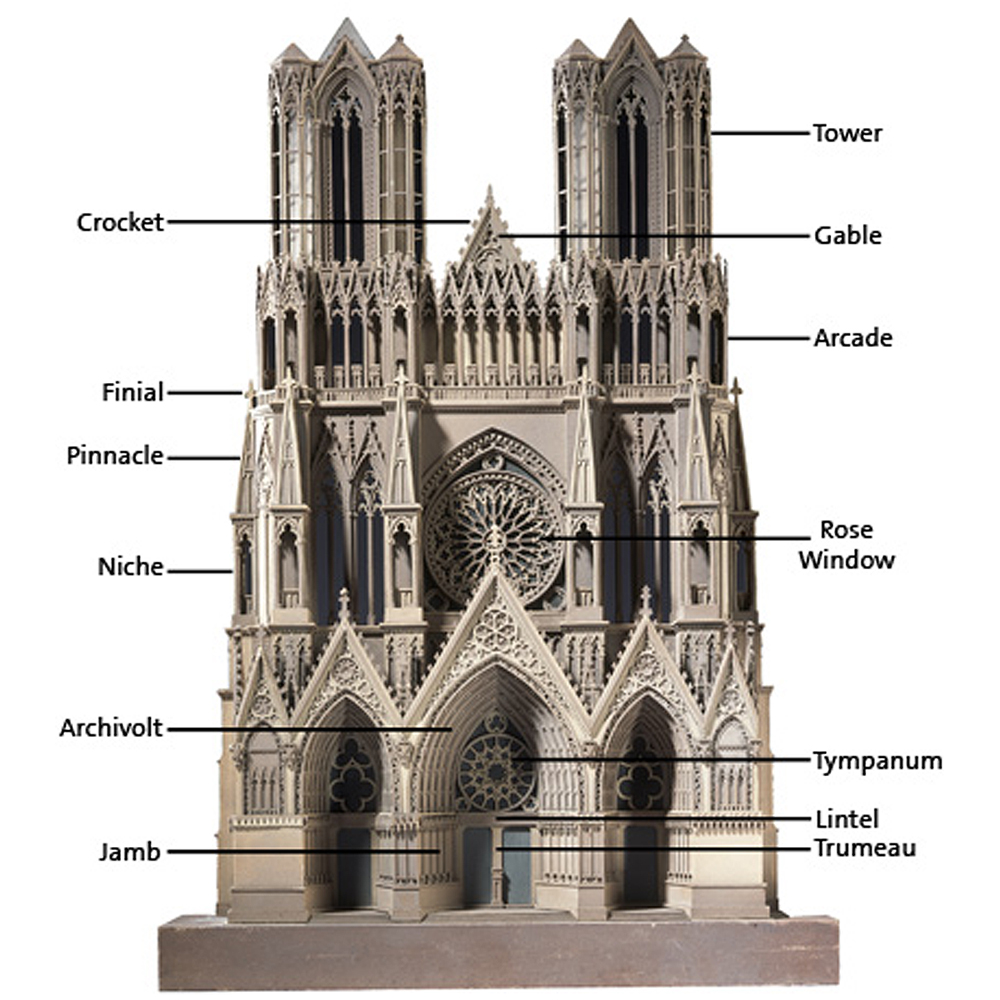
They have elements that help define them as cathedrals: narthex, nave, transept, choir, ambulatory, towers, gables, pinnacle, niche, tympanum, rose window … and so on. Other structures may contain these elements, but are not cathedrals, but nearly all cathedrals will contain these elements – and something more.
At the heart of a story is a point. It may not be a “big” point, or a good point, and it may not be one consciously conceived by its author, but if you look at the story long enough, you’ll find it. One may argue that it is there only because you’ve searched for it, and it’s the product of your searching more than it is of the author’s intention, but it doesn’t matter. Stories are for readers, an audience, and this is one of the things readers do with what they read – again, whether it was their primary intention or not. We read stories for many reasons, and some of those reasons we’re not conscious of at first, or even later, or ever.
At the heart of every cathedral, likewise, is a point. It is a manifestation of a view of the universe, of metaphysics, of theology.
It is a model of the universe as conceived by its initial adherents, perhaps, but it is more than a treatise written in stone, wood, and glass. And one doesn’t have to be an adherent to the worldview, or metaphysics, or theology, to appreciate the point the building makes.
It is a design, but it is not the product of any single designer (except for more recent examples); it is the product of many, laborers, craftspeople, artisans.
Each cathedral built along the general principles outlined by what we recognize as common or defining elements to the structure, but each one is distinct, different – its own experience. And every individual who journeys into the structure will find something distinct and, possibly, wondrous within it (and around it), beyond the intended tenets of any specific religion, spirituality, or theology.
And this is one reason why we are often moved so deeply when we visit these places. They are singular structures, but their very singular-ness is an echo of an entire reality – not to be mistaken for “reality” itself, whatever that is, but a response to reality, one of many within the human experience.
Which also can be said, without too great an exaggeration, of a story. The materials differ (thank heavens for that; fiction is cheaper and easier to carry around), but the results, potentially, are often the same.

Neither cathedrals nor stories should ever be taken for granted.